An intriguing city builder, though one that still needs some refinement.
I love any games that involves building a city, regardless of the conditions. Sim City? You’re building a city. They Are Billions? You’re building a city to protect it from zombies. Frostpunk? You’re building a city meant to stand against a generational storm that will freeze to death anyone who isn’t properly protected.
So you can imagine that when I saw the premise for Against the Storm that I was intrigued. To break down the general ‘plot,’ as it were, the world is plagued by a recurring storm known as the Blight Storm. The world will be at peace for a few years before this storm wipes out every town and settlement in existence in a process known as the Blight Cycle. When the Blight Storm arrives, the only safe place to flee is to the Smoldering City, where the power of the Scorched Queen is able to hold the Blight Storm at bay. Once the storm is over, people can once again go back out into the world to establish their colonies.
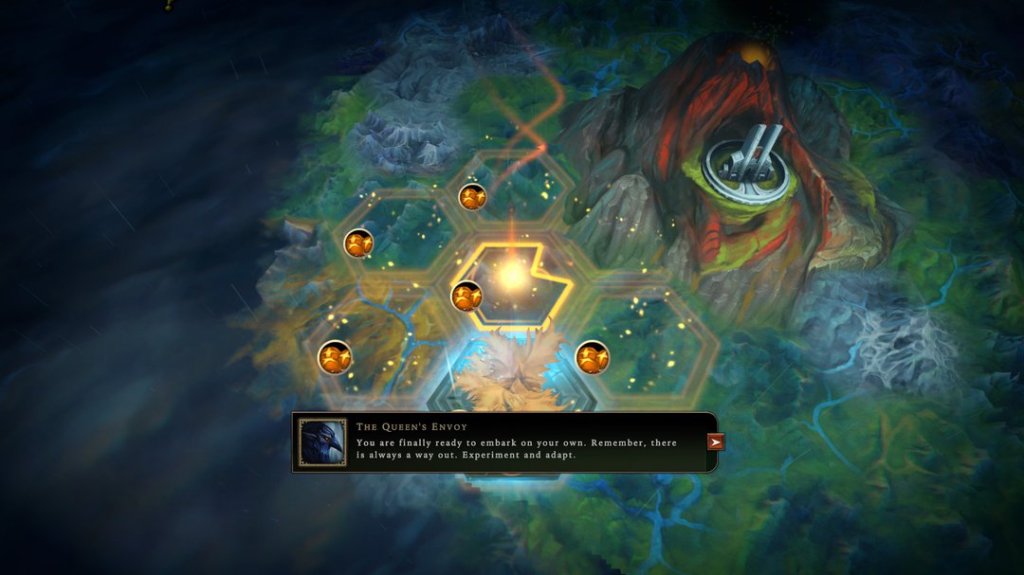
This is where the city builder aspect of the game kicks in. As the queen’s viceroy, it’s your job to rebuild the colonies that have been wiped out. As a rogue lite, every cycle resets the game and randomizes what you will find on the map as you engage in a another process of colony building. You start near the Smoldering City, build a colony, and if you are successful, continue to build successful colonies increasingly outward.
What this means for the player is that they must both make decisions on the world map regarding where they want to place their next colony, and then actually build the colony on the colony map. In the world map, you are afforded the chance to use your experience points to buy upgrades from the Smoldering City. You can purchase new buildings, for instance, which makes it easier to establish a colony. Or, you can buy resources that you can use once you enter the colonization phase of the game, making it easier to establish a successful colony.
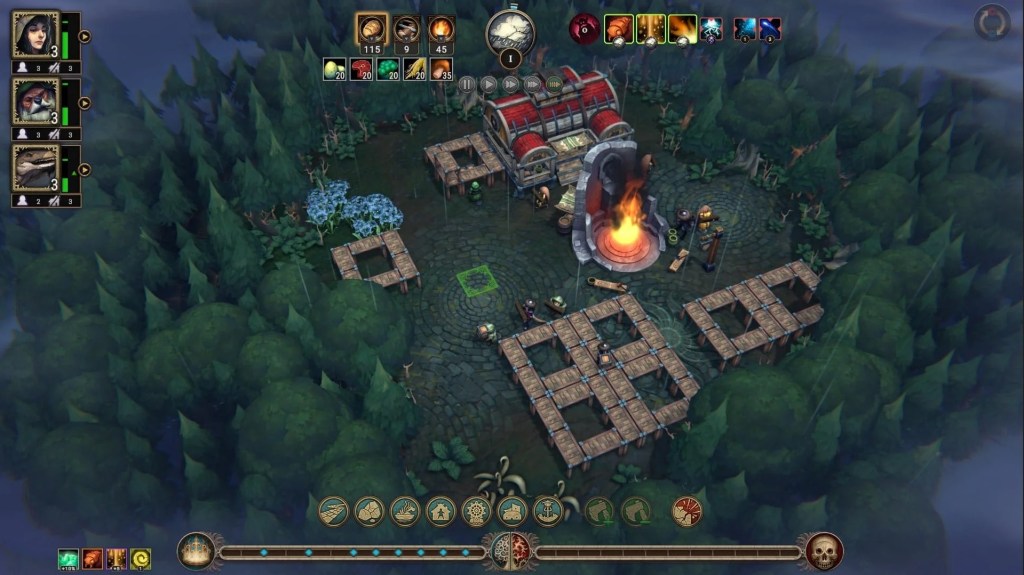
The colony map is where you’ll actually be spending most of your game time, however. Every colony is on a timer. Spend too long building the colony and the queen will run out of patience, ending your game. That impatience grows on a timer you can visibly see. However, achieving goals extends the amount of time you have, reducing her impatience. Achieving goals also fills up your achievement bar and, when that’s full, you win the map you’re currently playing on. These achievements typically take the form of goods that are being requested by the Smouldering City. For instance, you may need to put together 10 packs of crops or 15 packs of building materials that will benefit the city and increase your chance of winning the current map. There are other, more interesting ways of building your achievement meter, though. As you carve your way through the woods to make more space for your town, you’ll find abandoned goods you can ship back. Again, not a very intriguing way of building your experience. Much more interesting are the mysterious threats you’ll find.
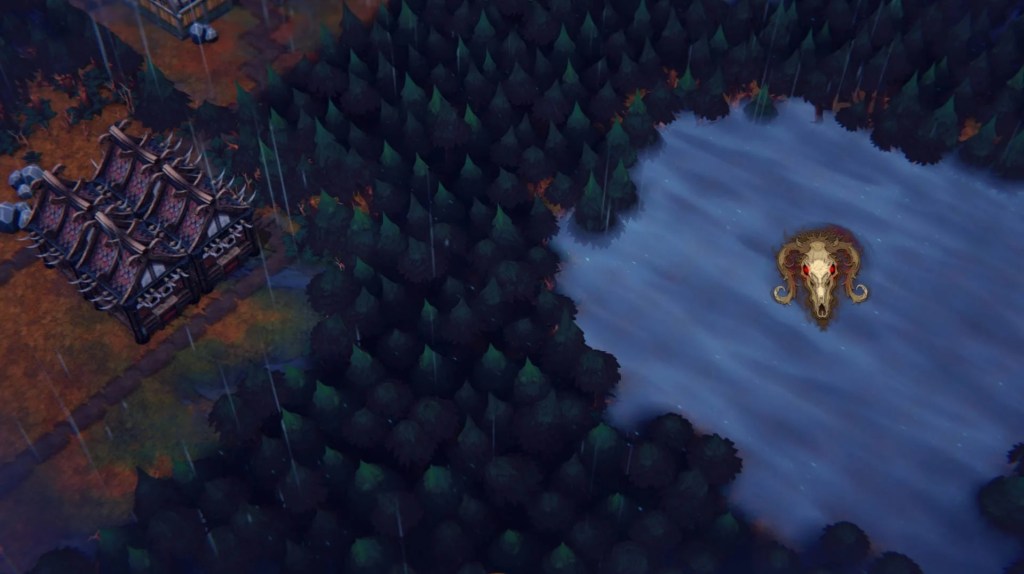
On your colony map, you’ll encounter glades blocked in by woods. Most of these hold new sources of food or materials for you to acquire. Others, though, hold threats. These dangerous glades can be filled with all kinds of dangers. In my play through, I’ve encountered escaped convicts, ancient heretical totems, abandoned ships, and mysterious temples. Fail to deal with these threats in a timely manner, and you could lose resources. In one instance, I took too long dealing with a mysterious temple we found and malevolent spirits burst out and killed a quarter of my town. How you deal with these threats, though, will influence your game. You could tear down a temple, for instance, and take the goods for yourself. Or, you could plunder its deepest secrets and send what you find back to the Smouldering City. Making decisions that benefit the queen will typically reward you with boosts to your experience meter.
The game is still in early access and I do have gripes about the game. There’s a lot of fun in seeing so many types of buildings. For instnace, you can have a tavern, a smokehouse, a cookhouse, a lumber mill, and a cooperage all in addition to more basic buildings like farms and woodcutter camps. Yet a lot of the time, I found myself thinking that many of the buildings felt redundant. You can greatly expand on what’s available to you over time, especially as you upgrade the Smouldering City from the world map, but after about a dozen hours, I felt like there was just a lot of content for content’s sake. It just felt like the game wanted you to have a lot available for its own sake. Does a town really need both a lumber mill and a carpenter’s cabin that both exist to produce planks of wood?
But I wonder how much of this is related to the directionless feeling of the game, overall. As you expand on the world map, you don’t really feel as if you’re doing it for any purpose except, again, simply to do it. This is something I believe the developers have noted they want to work on, and I think they are currently trying to add an overarching goal to the world map. That would at least give you something to work toward that makes it feel as if all the upgrades are for more than their own sake, or for the sake of simply completing more colonies. This game isn’t like They Are Billions, so playing the individual colony maps doesn’t have the thrill of desperately trying to beat off incoming threats. I also wonder sometimes if I am simply playing the game wrong. I’ve defeated multiple maps but often feel as if doing so requires essentially repeating the same processes. I don’t feel like it should take a dozen hours and three world resets to start feeling as if more intriguing environments or threats were coming. Still, this is a promising game so far and I don’t regret my purchase at all. I look forward to seeing how the overarching goals impact the game and how I feel about the upgrade system. It’s a charming city builder with a unique setting and I look forward to more in the future.